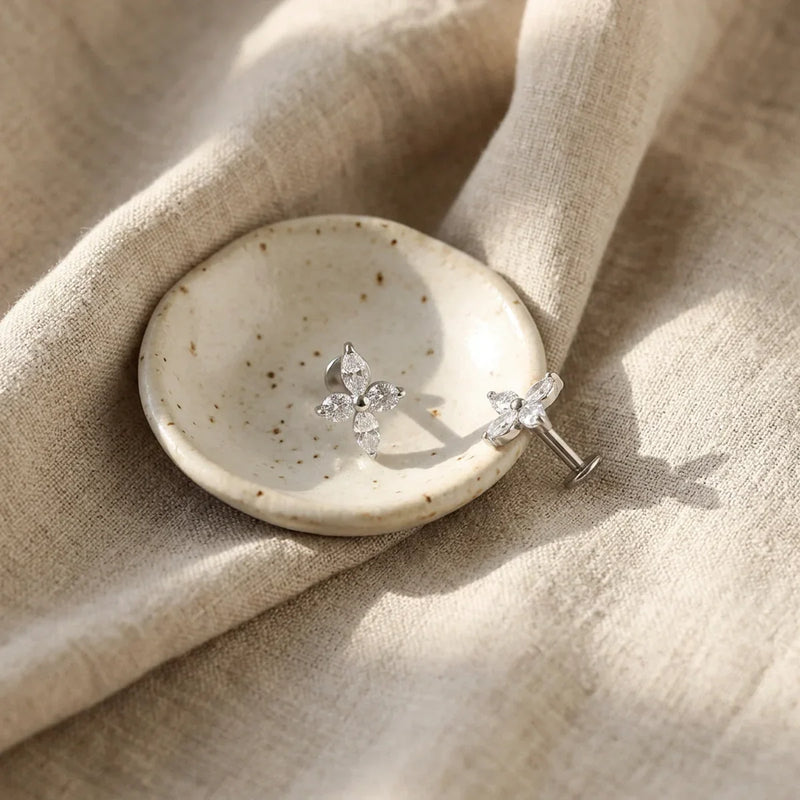
Cartilage earrings


How to choose cartilage earrings
Three details matter more than looks: gauge, length and back. Most cartilage piercings are done at 16 gauge (1.2 mm), and some at 18 gauge (1.0 mm). Post length depends on the thickness of your ear and on the placement, so a helix and a tragus rarely take the same size. If you don't know your measurements, ask the studio that pierced you. It is the quickest way to a comfortable fit.
The back comes next. Flat back earrings close with a small disc instead of a butterfly, so nothing presses into your head when you lie down or pull on a hat. Threadless tops push into the post and hold by tension, which makes them easy to swap once your piercing is healed. You'll find both in our flat back earrings collection, and the push-in style in our threadless earrings.
Last comes the shape. Tiny cartilage earrings, a single stone or a little star, suit the upper ear and the forward helix. Circle and spiral cartilage earrings bring movement to the rim, while a small hoop is the natural choice for the conch or daith.
Materials and care for cartilage ear piercing earrings
Jewelry in the upper ear touches pillows, phones and hair products every day, so the material is worth a moment of thought. Implant-grade titanium is light and contains no added nickel, which is why it is popular for hypoallergenic cartilage earrings. Our titanium flat back earrings are a good place to start.
Stainless steel cartilage earrings in 316L are durable and keep their shine. The alloy does contain nickel, tightly bound in the metal, and most people wear it without trouble; very sensitive ears may still react. Gold cartilage earrings in our range are gold-plated, so check the base metal underneath on each product page. Our page on hypoallergenic earrings explains the differences without hype.
Care is simple. Clean the jewelry, not the piercing, with mild soap and warm water, then dry it well. Check now and then that flat backs and threadless tops are snug. Every piece here is meant for healed piercings: if yours is new, sore or swollen, leave jewelry changes to your piercer and ask for advice first.
How to style upper ear cartilage earrings
A curated ear looks best when it follows the shape of your ear rather than a rulebook. Start with one focal point, such as a conch hoop, then add smaller pieces around it. Odd numbers feel more natural than even ones: one, three or five sparkles across the ear.
Keep the scale gentle as you move up. Bigger pieces belong lower, tiny ones higher, so the eye travels upwards. A conch hoop pairs nicely with two small studs on the helix, and a chain between two holes adds a playful link. No second hole yet? An ear cuff gives the same upper ear effect without a piercing.
Mixing gold-tone and silver works when each color appears at least twice. If you want a calmer look, choose one metal and vary the shapes instead.
Who they suit and when to wear them
Cartilage jewelry has no gender. A women cartilage earring with a stone can look very delicate, while a plain flat disc or a small dark hoop reads as minimal on anyone. Many people simply wear the same pieces for weeks, because flat backs are so comfortable.
For the office, choose tiny studs and keep the rest of the ear quiet. For evenings, add sparkle in one spot, for example a jewelled daith earring, which sits in the inner fold and catches light when you turn your head. As a gift, cartilage jewelry works best when you know the size; otherwise an ear cuff is the safer surprise.
Cartilage placements and matching styles
| Placement | Where it is | Styles that suit it |
|---|---|---|
| Helix | Outer upper rim | Flat back studs, small hoops |
| Forward helix | Front of the rim, near the face | Tiny flat back studs |
| Conch | Inner cup of the ear | Studs or a larger hoop |
| Daith | Inner fold above the ear canal | Small hoops and rings |
| Tragus | Small flap in front of the canal | Very small flat back studs |
Each product page lists gauge and post length, so you can compare them with your own sizes before you order.
More cartilage and upper ear ideas
If you want comfort first, our flat back collection gathers every disc-back and threadless style in one place. Pair those pieces with something in the lobe and the whole ear starts to tell one story.
Build slowly, one piece at a time, and swap often. Cartilage earrings are small, but together they change how your whole profile looks.