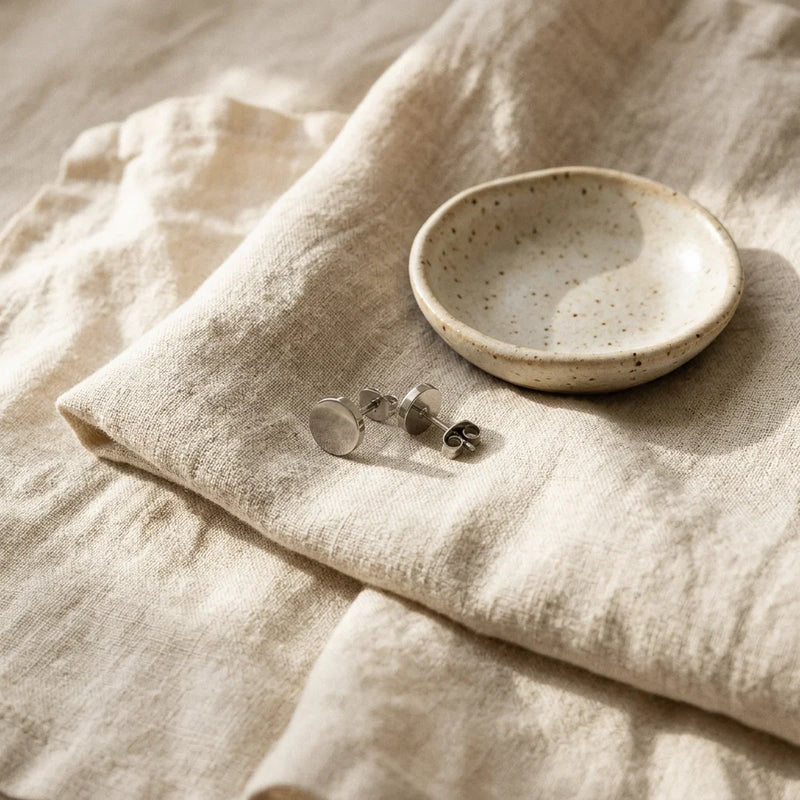
How to clean silver earrings safely, from light haze to heavy tarnish

How to clean silver earrings: for light dullness, wash them in lukewarm water with a drop of mild soap, then dry and buff with a soft cloth. For darker tarnish on solid sterling silver, a baking soda and aluminium foil bath works well (on our sterling silver earrings too). Skip toothpaste and harsh dips, and always check for pearls or plating first.
Silver earring cleaning methods at a glance
There is no single right way to clean silver. The best method depends on how tarnished your earrings are and what else is on them. Start with the gentlest option and move up only if you need to.
| Method | Best for | Time | Avoid on |
|---|---|---|---|
| Dry microfibre cloth | Fingerprints, light haze after wearing | 30 seconds | Nothing; safe for all pieces |
| Mild soap and lukewarm water | Everyday grime, skin oils, makeup | 5 minutes | Glued stones if soaked for long |
| Silver polishing cloth | Light to moderate tarnish on smooth surfaces | 5 minutes | Plated pieces, pearls, oxidised details |
| Baking soda and aluminium foil | Heavy tarnish on solid sterling silver | 10 to 15 minutes | Pearls, porous stones, glued settings, oxidised finishes |
| Commercial silver dip | Stubborn tarnish in deep crevices | Seconds | Pearls, soft stones, plated or rhodium-finished silver |
Most of the time, the first two methods are all you need. The stronger ones are useful a few times a year for pieces that have been sitting in a drawer, not for weekly maintenance.
Why silver earrings tarnish
Tarnish is not dirt and it is not rust. It is a thin layer of silver sulfide that forms when silver reacts with sulfur compounds in the air. The reaction starts as a faint yellow tint, moves through warm brown and ends as the grey-black film you see on forgotten jewellery.
Several everyday things speed it up:
- Humidity. A steamy bathroom is one of the worst places to store silver.
- Sulfur sources. Rubber bands, wool, felt, some cardboard boxes and foods like eggs and onions release sulfur compounds.
- Cosmetics. Perfume, hairspray, lotions and sunscreen leave residues that react with the metal.
- Chlorine and salt water. Both can discolour silver quickly and are best avoided completely.
- Skin chemistry. Some people's sweat darkens silver faster than others', which is perfectly normal.
Interestingly, wearing silver often slows tarnish down. The gentle friction against skin and clothing polishes the surface a little every day, which is why the earrings you never take off often look brighter than the ones in your jewellery box.
It also helps to separate tarnish from wear. Tarnish sits on the surface and comes off with the methods below. Scratches, dents and a dull, frosted look on edges are physical marks in the metal itself. A cleaner will not remove them, but a jeweller can professionally polish solid silver if the marks bother you. Plated pieces are different again: once the coating has worn through, cleaning reveals the base metal rather than fresh silver.
Know your silver before you start
Before you pick a method, take a moment to check what you are actually cleaning. Not every silver-coloured earring is made the same way, and a method that suits one can damage another.
The easiest clue is a tiny stamp on the post, the back or the inside of a hoop. Look for 925, STER or sterling for sterling silver, and 999 for fine silver. Letters like EP, SP or EPNS usually mean silver plated. No stamp at all does not prove a piece is not silver, especially on very small earrings, so check the product description too.
Sterling silver
Sterling silver, usually stamped 925, is 92.5% silver mixed with 7.5% other metals, most often copper, to make it stronger. The copper is also why sterling tarnishes. It is solid all the way through, so it tolerates every method in the table above.
Fine silver
Fine silver, stamped 999, is almost pure. It tarnishes more slowly than sterling but is also softer, so it scratches and bends more easily. Clean it with soap and water or the foil bath, and treat polishing cloths with a light hand.
Rhodium-plated silver
Many sterling pieces are finished with a thin layer of rhodium, a bright white metal that resists tarnish and scratches. Rhodium rarely needs more than soap and water. Rubbing it with polishing compounds can wear it away and leave patches of softer, yellower silver.
Silver-plated and silver-tone pieces
Silver-plated earrings have a thin silver layer over a base metal such as brass or copper. Silver-tone pieces may have no silver at all, just a coating or a stainless steel surface. Treat both like plated gold: gentle soap, no abrasives, no dips. If you are unsure how plating behaves, our guide on whether gold plated jewelry tarnishes explains why thin coatings need extra care.
Oxidised silver
Some designs are deliberately darkened in the recesses to add depth and contrast. That dark finish is a controlled form of tarnish, so strong cleaning removes it. Clean these with soap and water only, and polish just the raised areas if you must.
How to clean silver earrings with soap and water
This is the method to use most often. It removes skin oil, makeup and the light haze that builds up with wear, and it is safe for almost everything.
- Fill a small bowl with lukewarm water. Avoid hot water if the earrings have stones or glued parts.
- Add a few drops of mild, fragrance-free washing-up liquid or a gentle unscented soap.
- Let the earrings soak for two to five minutes to loosen residue.
- Brush gently with a very soft, clean toothbrush, paying attention to the post, the back and any textured areas.
- Rinse under clean running water with the sink plug in, so nothing disappears down the drain.
- Pat dry with a soft cloth, then leave them on a towel for a while so every crevice dries completely.
- Finish with a light buff using a dry microfibre or cotton cloth.
Thorough drying is the step most people skip, and it matters. Moisture left inside a hinge or a hollow hoop is one of the main reasons silver darkens again quickly. Hollow and hinged styles like our silver hoop earrings need this step most.
The baking soda and foil method for heavy tarnish
When solid sterling silver earrings have turned grey or black, this method reverses tarnish rather than scrubbing it off. The aluminium foil, hot water and baking soda create a small chemical reaction that turns silver sulfide back into silver. Because no metal is removed, it is gentler on the surface than abrasive polishing.
- Line a heat-proof glass or ceramic bowl with aluminium foil.
- Place the earrings on the foil, making sure each one touches it.
- Sprinkle about one tablespoon of baking soda for every cup of water you will use.
- Pour in very hot water, enough to cover the earrings completely. It will fizz and may smell faintly of eggs; that is the sulfur leaving the silver.
- Wait five to ten minutes. For heavy tarnish, carefully turn the pieces with a wooden or plastic utensil and repeat with fresh water.
- Remove with tongs, rinse well in clean water and dry thoroughly.
Use this method only on plain sterling silver. It will remove intentional oxidised detailing, it can loosen glue, and the heat and alkalinity are not suitable for pearls, opals, turquoise or other porous materials. Do not use it on plated pieces either.
Do not expect a mirror finish straight out of the bath. The foil method lifts the dark layer and often leaves silver looking clean but slightly matte. A quick buff with a soft cloth afterwards brings back the shine. If some grey remains in deep grooves, that is normal on textured designs and usually fades with the next soap-and-water clean.
Polishing cloths and silver dips
A two-part silver polishing cloth is a convenient middle ground. One side is usually treated with a mild polishing compound that lifts tarnish, and the other side buffs the surface to a shine. Rub with gentle, straight strokes rather than circles, which can leave fine swirl marks. When the cloth turns black, it is doing its job; do not wash it, or the compound will rinse out. Replace it once it stops working or feels gritty.
You may also see a paste of baking soda and water recommended online. It does work, but it is mildly abrasive and can leave fine scratches on high-polish silver. If you try it, use very little pressure, rub with your fingertip rather than a brush, and rinse thoroughly. On smooth, shiny earrings, a polishing cloth or the foil bath is usually the safer choice.
Liquid silver dips work in seconds and reach into tiny gaps where a cloth cannot go. They are also the harshest option. Dip only for the time stated on the label, rinse thoroughly straight away and dry well. Never use a dip on pearls, soft or porous stones, plated silver or rhodium-finished pieces, and keep it away from your skin and eyes.
Cleaning silver earrings with pearls, stones and details
Mixed-material earrings need the most care. A good rule: clean the silver around the decoration, not the decoration itself.
Before you start, look closely at how each stone or pearl is attached. Claws, bezels and prongs hold a stone mechanically and cope well with water. A pearl on a peg or a flat stone on a smooth base is usually glued, and glue softens with heat, long soaks and chemicals. When in doubt, keep the decorated part dry and work around it with a cloth.
- Pearls. Pearls are soft and react badly to acids, heat, chemicals and long soaking. Wipe them with a damp, soft cloth and dry immediately. Clean the silver parts with a dry polishing cloth, holding it away from the pearl.
- Cubic zirconia. Zirconia is hard and tolerates soap and water well. A soft toothbrush behind the stone brings back its sparkle. Avoid the foil bath if the stones are glued rather than set with claws.
- Enamel and resin. Use only lukewarm soapy water and a soft cloth. Hot water and chemicals can cloud or crack the surface.
- Hinges and clasps. Brush gently, then dry with extra care. Trapped moisture here causes both tarnish and stiffness.
For hygiene, you can also wipe the post with a cotton pad lightly dampened with isopropyl alcohol now and then, keeping it away from pearls, resin and enamel. This is especially useful if you share earrings or have just finished healing a piercing.
What not to use on silver earrings
Many popular home hacks do more harm than good. Avoid these:
- Toothpaste. It contains abrasives that leave tiny scratches and dull the surface over time.
- Bleach and chlorine cleaners. They can pit and permanently discolour silver.
- Strong acids. Long soaks in vinegar or lemon juice are unnecessary on silver and harmful to pearls and stones.
- Paper towels and tissues. Their fibres are more abrasive than they look.
- Ultrasonic cleaners at home. They are fine for plain sterling silver but can shake loose glued stones and damage pearls.
- Scouring pads or stiff brushes. Silver is a soft metal and scratches easily.
How to keep silver earrings from tarnishing
Prevention is far easier than cleaning. A few habits keep silver bright for months:
- Put earrings on after makeup, perfume and hairspray, and take them off before showering, swimming or exercising.
- Wipe them with a dry cloth before you put them away.
- Store each pair in a small zip bag with the air pressed out, or in a closed box with separate compartments.
- Add an anti-tarnish strip or a small silica gel sachet to absorb moisture and sulfur.
- Keep jewellery out of the bathroom and away from rubber bands, wool and felt-lined boxes that are not designed for silver.
- Wear your silver regularly; light daily friction is a natural polish.
How often to clean silver earrings
A dry wipe after each wear is enough for most days. A soap-and-water wash every few weeks keeps residue from building up, and more often if you wear the same pair daily or live somewhere hot and humid. Save polishing cloths, the foil bath and dips for when you actually see tarnish. Cleaning too aggressively too often wears down fine details and plating faster than tarnish ever would.
If silver sometimes irritates your ears, the cause is often not the silver itself but the alloy or a worn plating. Our guide to the best earrings for a nickel allergy covers which metals tend to be better tolerated, and the hypoallergenic earrings collection gathers pieces chosen with sensitive ears in mind.
Silver earrings at Odelys that are easy to care for
Simple shapes with smooth surfaces are the quickest to clean and the slowest to show tarnish. These silver styles fit an easy care routine:
- Silver huggie earrings: close-fitting and smooth, so there are few corners for residue to collect.
- Silver ear cuff: no post to clean, just buff the band and store it flat so it keeps its shape.
- Silver pearl earrings: polish the metal with a dry cloth and wipe the pearl separately with a damp one.
- Men's silver ear studs: a minimal stud that stays bright with soap, water and regular wear.
Check each product page for the exact metal and finish before you choose a cleaning method, and when in doubt, start with soap and water. Gentle is almost always enough.