How to stack earrings: a simple formula for a curated ear
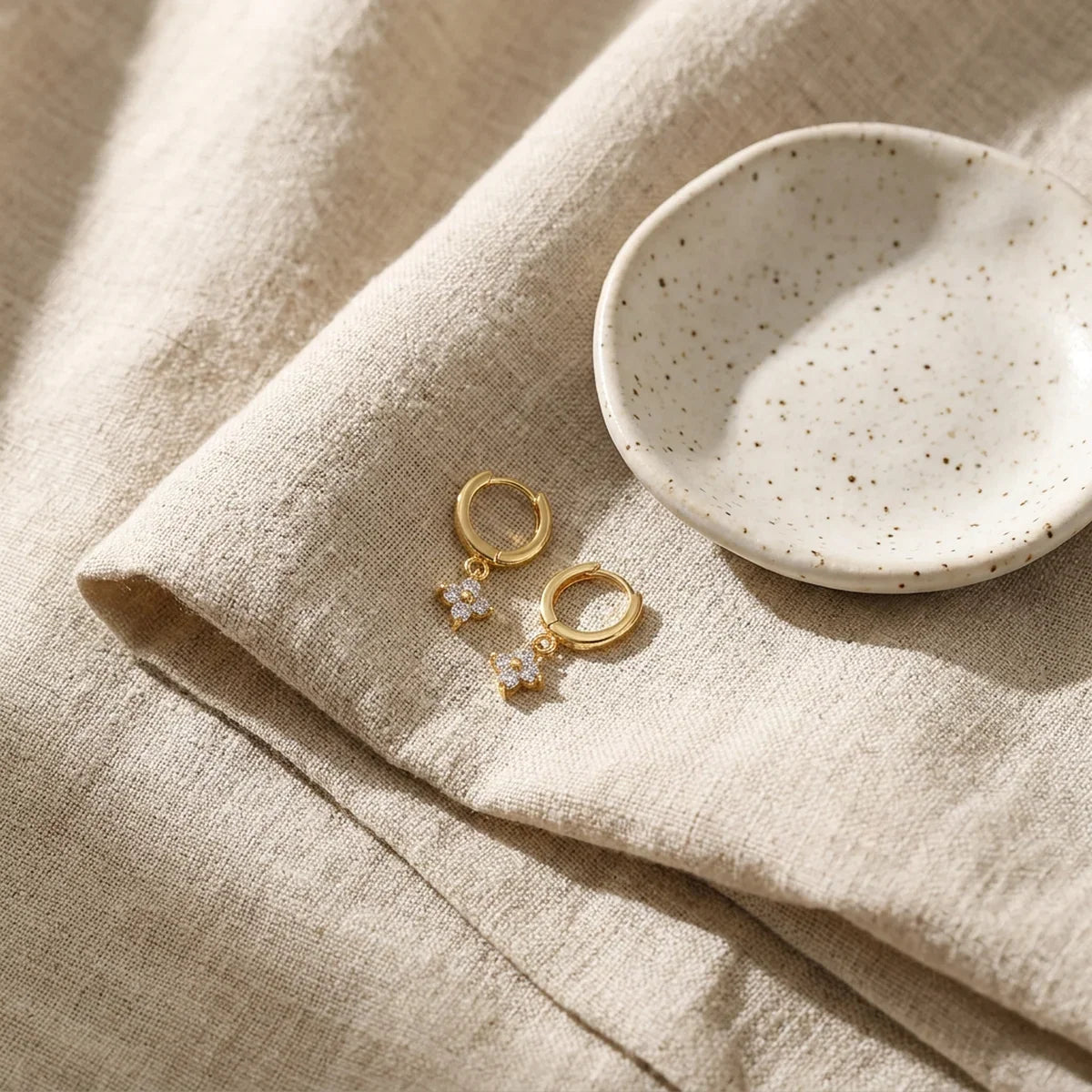
How to stack earrings in one sentence: start with the largest piece in your first lobe piercing and get smaller as you move up the ear: a huggie or hoop at the bottom, a small stud in the second hole, a tiny stud or cuff on the cartilage. Stick to one metal or mix two on purpose, and give the stack one focal point.
The stacking formula at a glance
Why stacks work so well
A stack lets you wear more of what you love without any single piece feeling too much. Small earrings that would look almost invisible alone become a design when they are arranged together, and you can change the mood of the whole ear by swapping just one element. It is also a gentle way to express personality at work: no single earring is loud, yet the composition says a lot about your taste. Finally, stacks grow with you. You can start with two pieces and add a third, a fourth or a cuff over months, building a collection that feels personal rather than bought all at once. The table below gives every position a role, so each new piece has an obvious place to go.
| Position | Role in the stack | What to wear |
|---|---|---|
| First lobe | The anchor, the biggest piece | Huggie of 10 to 12 mm, small hoop, pearl or a short drop |
| Second lobe | The link | Huggie of 8 mm or a 4 to 5 mm stud |
| Third lobe or upper lobe | The quiet detail | A 2 to 3 mm stud, a tiny star or dot |
| Helix (outer rim) | The surprise | A 6 to 8 mm hoop, a flat back stud or an ear cuff |
| Conch or tragus | The accent | A small flat back stud or a slim hoop |
You do not need every position. Two lobe piercings and a cuff already make a convincing stack, and a single lobe piercing plus a cuff is enough to try the look. The principle stays the same: big at the bottom, small at the top, one piece that stands out.
Start by mapping your ear
Before buying anything, look at your ear in a mirror and note what you already have. Count the lobe piercings and see whether they sit in a straight line, a curve or a diagonal. Check the shape of your rim, how much flat space there is inside the ear and how big your lobe is.
Name your piercings
Knowing the names helps you shop for the right size and post. The lobe is the soft lower part; the helix is the outer rim of cartilage; the flat is the smooth area inside the rim; the conch is the hollow in the centre; the tragus is the small flap in front of the ear canal. Our guide to ear piercing names shows each one with its usual jewellery size.
Measure the space
For huggies and hoops, measure from the hole to the edge of the lobe or rim. That distance tells you the smallest diameter that will close comfortably. Upper positions usually need small sizes, often 6 to 8 mm, while the first lobe can take larger pieces. If in doubt, our huggie sizes guide explains how to measure in a couple of minutes.
Look at the angle of each hole
Piercings are rarely perfectly straight. Some point slightly forward, others slightly up or down. A stud will follow that angle, which is fine, but a hoop in an angled hole can twist or sit unevenly. If one of your holes is noticeably angled, give it a stud or a small huggie that sits close to the skin, and keep the hoops for the straightest piercings. This one detail explains most stacks that never quite look right.
The rules that make a stack look good
Stacks look effortless when they follow a few quiet rules. You can break any of them, but it helps to know them first.
Graduate the sizes
The most reliable rule is a gentle size gradient: the largest earring in the first lobe, slightly smaller in the second, tiny at the top. It guides the eye upward along the ear and looks balanced from every angle.
Choose one focal point
A stack with three statement pieces feels busy. Pick one star, such as a sparkling huggie, a pearl or a coloured stone, and let the others support it with plain metal or tiny stones.
Play with shapes, not only sizes
Mix circles with points of light. A hoop, a dot and a star look more interesting together than three identical studs. Repeating one element twice, for example two stars of different sizes, ties the stack together.
Leave some space
Earrings that touch each other can tangle, scratch or pull. Give each piece a little breathing room, especially hoops in neighbouring holes. If two piercings are very close, put a stud in one and a slim huggie in the other.
Think in odd numbers
Three or five points usually look more natural than two or four. If you have two piercings, adding a cuff to make a third point often completes the look.
Gold, silver or both?
Metal colour decides whether a stack feels polished or relaxed.
- All gold-tone: warm, rich and cohesive. Ideal if your other jewellery is gold.
- All silver-tone: clean, bright and modern, perfect with cool tones and white stones.
- Mixed on purpose: combine gold and silver by alternating them, or keep the lobe in one colour and the cartilage in the other. Adding a piece that contains both colours, or a stone that suits both, makes the mix look deliberate.
Rose gold-tone sits between the two and works as a bridge when you mix. Whatever you choose, keep the same finish throughout, all polished or all brushed, so the stack reads as one composition.
Adding stones and colour
Clear cubic zirconia goes with both gold and silver and adds light without changing the colour story. If you want colour, introduce it once: a turquoise huggie, an amethyst stud or an opal drop as the focal point, with plain metal around it. Two different coloured stones can work if they share a tone, for example soft blue and green, but more than that tends to look busy rather than curated.
Stacking without new piercings
You can build a stack even if you only have one hole in each lobe. Ear cuffs sit on the rim of the ear without a piercing and create the illusion of a cartilage stack in seconds.
A simple formula is a huggie in the lobe and a cuff halfway up the ear. If you want more, add a second cuff higher up, choosing a slimmer style so the top of the stack stays light. Browse our ear cuff collection to find chunky and slim options that work together, and change them as often as you like.
Single side or both ears?
Asymmetric stacks are very current: a full stack on one ear and a single stud or huggie on the other. It looks intentional and lets you show off your favourite side, often the one where you part your hair. Symmetric stacks work too, especially for formal events, but they take more pieces and can feel heavier.
Five stacks you can copy
These combinations work for most ears and can be adapted to the piercings you have.
- The minimal stack: a plain gold huggie in the first lobe, a tiny gold stud in the second, nothing else. Perfect for work and everyday.
- The sparkle stack: a huggie with a row of cubic zirconia, a small star stud and a slim cuff with stones. Bright without being loud.
- The pearl stack: a pearl stud in the first lobe, a small gold huggie in the second and a tiny dot on the helix. Soft and elegant for weddings and dinners.
- The playful stack: a star huggie, a clover hoop and a tiny stud, mixing symbols for a personal, collected look.
- The bold stack: a chunky hoop in the first lobe, a plain huggie next to it and a chunky cuff on the rim. Strong, modern and great with hair pulled back.
For special occasions, you do not need a new stack. Keep your everyday base and swap only the focal point: replace the plain lobe huggie with a pearl or a short crystal drop, and leave everything above it as it is. The stack stays familiar and comfortable, but the ear suddenly looks dressed up. The same trick works in reverse for sport or travel days, when you can remove the focal piece and keep only the small studs and flat backs that never get in the way.
Find the base pieces in our huggie earrings and stud earrings collections, then add one detail at a time until the stack feels finished.
Stacks for men
Stacking is not only for women. A classic men's stack is a small plain huggie in the first lobe and a dark or silver stud in the second, or two plain huggies of slightly different sizes. Keep the metals matte or polished but not sparkly, and choose clean round shapes. If you only have one piercing, a hoop plus a magnetic or clip stud next to it gives the same effect without a new hole.
Comfort and everyday practicalities
A stack you wear every day should also be comfortable to sleep in, put on and take off.
- Choose closures that do not snag: hinged huggies and flat backs are the most practical for stacks, because nothing sticks out at the back. See our guide to the types of earring backs for the details.
- Use flat backs on cartilage: threadless or screw flat backs sit flush against the head and are far more comfortable on a pillow than butterfly backs.
- Keep the top light: heavy pieces belong in the lobe. Cartilage piercings prefer small, light jewellery.
- Change one piece at a time: it is easier to keep the stack balanced, and you will not leave several holes empty at once.
Sleeping with a stack
Small huggies and flat back studs are usually fine overnight. If a hoop or cuff presses when you lie on that side, take it off at night or sleep on the other side. Never sleep in ear cuffs, as they can slip off and bend.
Headphones, phones and helmets
Think about what touches your ears during the day. Over-ear headphones press on the helix and on cuffs; in-ear buds can catch on tragus jewellery; a bike or ski helmet pushes against everything on the side of the head. If you use any of these daily, keep the cartilage pieces small and flat, and save chunkier cuffs for evenings and weekends.
Sensitive ears and cartilage piercings
Stacks mean more metal in contact with your skin, so material matters more than with a single pair. If your ears react easily, choose implant-grade titanium or clearly labelled 316L steel, especially for cartilage. Fresh piercings should only wear the jewellery recommended by your piercer until they are fully healed, which takes longer for cartilage than for the lobe.
Our hypoallergenic earrings and cartilage earrings collections list the metal of every piece, and the guide to the best earrings for nickel allergy explains what to look for.
Our favourite pieces for an ear stack
These earrings were chosen because they combine easily with each other and suit different positions in the ear.
- Silver huggie earrings: a row of square cubic zirconia, a perfect sparkling anchor for the first lobe.
- Star huggie hoop earrings: little zirconia stars that add a playful accent in gold or silver.
- Star stud earrings: tiny 925 silver stars in 3, 4 or 5 mm, ideal for upper holes.
- Clover earrings: a small hoop with a cubic zirconia clover for a romantic touch.
- Minimalist ear cuff: a slim cross with stones that adds a cartilage point with no piercing.
- Threadless earrings: a flat back trinity top in 316L steel for helix, tragus or upper lobe.
Mistakes to avoid
A few common slips turn a curated ear into a cluttered one.
- Everything the same size: without a gradient, the stack looks flat. Vary diameters and stone sizes.
- Too many statements: one focal point is enough; the rest should support it.
- Hoops that clash: two hoops in neighbouring holes can knock and tangle. Pair a hoop with a stud instead.
- Heavy jewellery on cartilage: it pulls, presses and makes sleeping uncomfortable.
- Ignoring your hair: if you always wear your hair down on one side, build the stack on the side that shows.
A good stack grows over time. Start with two or three pieces you love, wear them for a few weeks and add one detail when you feel something is missing. The best curated ears look personal because they were built slowly, one earring at a time.
A sensible order to build your stack
If you are starting from scratch, buy in this order. First, the anchor for your first lobe, because it sets the metal and the mood. Second, a small stud that links it to the rest. Third, a cuff or a cartilage piece that adds height. Wear each new piece for a week before adding the next; you will quickly see whether the stack needs more sparkle, more simplicity or simply more space. This slow approach also stops you from buying pieces that look lovely alone but never find a place in your ear.