Types of earrings: a complete guide to every style and how to choose yours

The main types of earrings are studs, hoops, huggies, drops, dangles, threaders, ear cuffs, climbers and clip-ons. They differ in three ways: how they sit on the ear, how far they hang and how they fasten. Studs and huggies are the easiest to wear every day, while drops and bigger hoops shine on a night out.
Types of earrings at a glance
Before going style by style, here is the short version. Find the shape that fits your day in the table, then jump to the section that explains it.
| Type | How it sits | Typical size | Works best for |
|---|---|---|---|
| Stud | Flat on the lobe, post through the piercing | 3–10 mm face | Every day, work, layering |
| Hoop | A circle that passes through the piercing | 15–60 mm diameter | Casual looks to evenings |
| Huggie | A small, thick hoop that hugs the lobe | 6–12 mm inner diameter | Daily wear, stacking |
| Drop | Hangs just below the lobe, little movement | 1–3 cm long | Office, weddings, dinners |
| Dangle or chandelier | Hangs and moves freely, often in tiers | 3–8 cm long | Events, statement outfits |
| Threader | A fine chain or bar pulled through the hole | 5–12 cm in total | Minimal outfits, second holes |
| Ear cuff | Wraps the outer rim, usually no piercing | 8–15 mm | Interest without a new hole |
| Ear climber | Runs up the edge of the ear from the lobe | 1.5–3 cm | Lightweight drama |
| Clip-on | Pinches the lobe with a hinged pad | Varies | Unpierced ears |
Two details matter more than the name on the label. The first is size, which is almost always given in millimetres. The second is the closure. A stud and a drop can share the same push back, and a hoop can close with a hinge, a latch or a simple wire. Once you know those two things, every product page becomes much easier to read.
Keep in mind that the names overlap. Some shops call any earring that hangs a "drop", others reserve the word for short, still designs. A huggie is technically a hoop, and a threader can behave like a drop. Do not worry about the labels too much: look at the length, the shape and the way the piece is attached.
Stud earrings: the everyday base
A stud is a single decorative front fixed to a straight post. The post goes through the piercing and a back holds it in place behind the lobe. Because nothing hangs, studs do not swing, catch on scarves or tangle with hair. That is why they are the first pair most people buy after a piercing and the pair many people never take off during the week.
Studs come in more shapes than the classic round stone. You will find tiny metal balls, geometric shapes, stars and moons, enamel colours, pearl-style fronts and cubic zirconia set in a simple claw. Our heart earrings and star earrings show how much a small shape can say. A sparkling cubic zirconia front of 4 to 6 mm reads as polished without being loud, so it works for an interview as well as for dinner.
Choosing a stud size
On most lobes, 3–4 mm feels discreet, 5–6 mm is clearly visible and 8 mm or more starts to look like a statement. If you plan to stack several piercings, keep the smallest studs for the higher holes and the largest for the first lobe piercing. The visual line then grows from top to bottom, which tends to look balanced.
Flat back studs
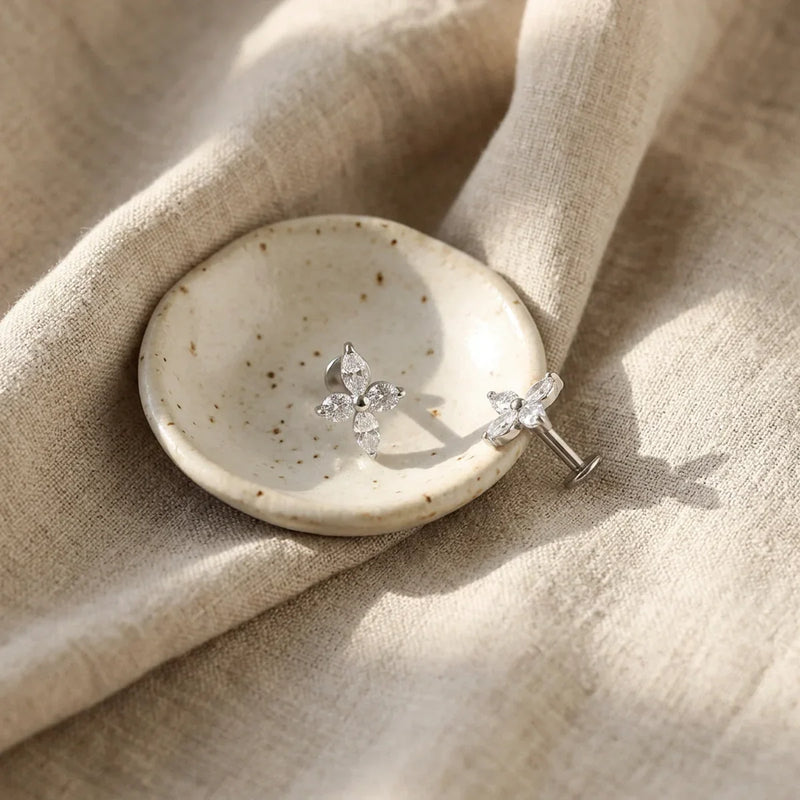
A flat back stud swaps the usual butterfly for a small disc that rests against the skin, while the decorative top screws or pushes into the post. It is comfortable for sleeping and talking on the phone, and it is the standard choice for cartilage piercings such as the helix or tragus. You can browse a full range in our stud earrings collection, flat back styles included.
Hoops and huggies: the circle family
A hoop is any earring shaped as a full or near-full circle that passes through the piercing. It is one of the oldest jewellery shapes there is and still one of the most worn. The variety inside this family is huge, so it helps to split it by size and thickness.
Hoops
Hoops are measured by their diameter, usually the inside one. Small hoops of 10–20 mm sit close to the lobe and look neat. Medium hoops of 25–40 mm are the classic choice that frames the face. Large hoops of 50 mm and more are a style statement and look best with simple clothes and hair pulled back. Thickness changes the mood too: a thin wire feels light and delicate, while a tube of 4–6 mm is often called a chunky hoop and looks bolder even at a modest diameter.
Hoops close in several ways. Endless hoops have a thin wire that slips into the tube. Hinged hoops have a small section that clicks shut. Latch-back hoops use a little hook that catches on the back. For daily wear, hinged and latch systems are the easiest to open and close with one hand.
Huggies
A huggie is a small, usually thicker hoop designed to sit snugly around the lobe, with an inner diameter typically between 6 and 12 mm. Most use a hinged clicker closure, so there is no loose back to lose. Huggies are easy to sleep in, they stack beautifully in a row of piercings and they often carry details such as a row of zirconia or a small charm. If you like a polished, minimal look, a pair of huggies may well become your default.
To see the whole family side by side, from tiny huggies to wide, statement circles, take a look at our hoop earrings.
Drops, dangles and chandeliers
As soon as an earring hangs below the lobe, it falls into the drop and dangle group. The difference is mostly about length and movement.
Drop earrings
A drop hangs a short distance below the lobe and moves only a little. Think of a single pearl-style bead on a short bar, a small pendant on a stud or a teardrop shape. Drops are a natural step up from studs: they catch the light when you turn your head and draw attention towards the face and the neckline, yet they still feel appropriate in an office. See the shape in our teardrop earrings. For a softer look, see our pearl drop earrings.
Dangle earrings
Dangles are longer and swing freely. They often hang from a fish hook wire, a curved wire that passes through the piercing and may have a small rubber stopper at the end for security. Lengths of 4–6 cm are common. Because they move, dangles add energy to a simple dress or a plain T-shirt.
Chandelier earrings
Chandeliers are the most elaborate version: several tiers or branches that widen as they go down, much like a light fitting. They are meant for events and pair well with an open neckline and hair worn up. Weight is the main thing to check, because a heavy chandelier can pull on the lobe over a long evening. For bold pieces that stay comfortable, see our statement earrings.
Our drop earrings collection gathers short drops and longer dangles in one place, so you can compare lengths before you decide.
Threaders, ear cuffs and climbers
This group breaks the rule that an earring has to sit at a single point. Each of these styles uses the shape of the ear itself.
Threaders
A threader is a fine chain or thin bar that you pull through the piercing so that part of it hangs in front and part hangs behind. There is no back: the weight on each side keeps it in place. You can adjust the length every time you wear it, which makes threaders surprisingly versatile. They are lovely in a second lobe piercing next to a stud.
Ear cuffs
An ear cuff is a curved band that slides onto the outer rim of the ear, usually the middle part of the cartilage. Most do not need a piercing at all: you open them slightly, slide them on and squeeze gently until they sit firmly. That makes cuffs the easiest way to try the look of a cartilage piercing before committing to one. Explore the different widths and finishes in our ear cuff collection.
Ear climbers and jackets
A climber, also called a crawler, goes through the lobe piercing like a stud, but its front is a long, slim shape that follows the edge of the ear upwards. An ear jacket does something similar from behind: a stud goes in the front and a second piece hangs below or behind the lobe, attached to the same post. Both give the impression of several piercings while using only one.
Clip-ons, magnetic and other options for unpierced ears
If your ears are not pierced, you still have choices. Clip-on earrings use a hinged back with a padded plate that pinches the lobe. Modern versions are much more comfortable than older ones, especially if the pad is coated in silicone. Screw clip earrings let you adjust the pressure with a tiny screw. Magnetic earrings hold a front piece and a back piece together through the lobe with a small magnet, and they suit very light, stud-sized designs. Browse every style in our clip-on earrings. Our guide to wearing earrings without piercing compares all three.
A practical tip: wear new clip-ons for short periods at first. Pressure on the lobe is the main reason they become tiring, and your ears need a little time to get used to them. If they still feel too tight, choose a lighter design rather than a larger one.
How to choose the right type of earring
With so many types of earrings available, the right one depends less on rules and more on how you actually live. These questions help narrow it down quickly.
What will you be doing?
- Sport, sleep or long days: small studs, flat back studs or huggies. Nothing to snag, nothing to lose.
- Office and meetings: studs, small hoops of up to 20 mm or short drops.
- Dinners and weekends: medium hoops, threaders, a single ear cuff.
- Weddings and events: dangles, chandeliers or large hoops, depending on the neckline.
What about face shape?
Face shape advice is a guide rather than a law, but contrast is the usual idea. Round faces often look great with longer drops that add a vertical line. Long, oval faces suit hoops and wider shapes that add width at the jaw. Angular faces soften with rounded hoops and curved drops, while heart-shaped faces are balanced by earrings that are wider at the bottom than at the top.
Hair and neckline
Long, loose hair hides small studs, so go slightly bigger or choose hoops that peek out. A high neck pairs best with studs and small hoops, while an open neckline leaves room for longer pieces. If in doubt, choose one focus: big earrings with a simple neckline, or a striking neckline with small earrings.
Building a small collection
Many people find that four pairs cover almost every situation: a pair of simple studs, a pair of huggies, a pair of medium hoops and a pair of drops. Add an ear cuff if you want to experiment without a new piercing. Choose them in the same metal tone and they will also mix with each other when you have more than one hole.
Materials and sensitive ears
The material matters as much as the style, especially for anything that goes through the piercing. Nickel is the most common cause of contact allergy to jewellery, so the metal of the post deserves a closer look than the decorative front.
- Titanium: very light and generally considered one of the safest choices for sensitive ears, which is why it is common for new and cartilage piercings. Browse our titanium earrings.
- 316L stainless steel: durable, affordable and low in released nickel. Many people with sensitive skin wear it without problems, though it does contain some nickel bound in the alloy.
- 925 sterling silver: 92.5% silver mixed with other metals, usually copper. It can darken over time but is easy to clean.
- Gold-plated and gold-tone pieces: a thin layer of gold over a base metal. Treat them kindly and they keep their colour for a long time; how long depends on the base and the thickness of the plating.
"Hypoallergenic" is not a medical guarantee. It simply means the material is unlikely to cause a reaction for most people. If you know you react to nickel, choose titanium posts and check product details carefully. If you notice redness, itching or swelling, take the earrings out and ask a pharmacist or a doctor for advice.
A little care keeps any pair looking good: put earrings on after perfume, hairspray and creams, take them off for swimming and showers, and store them separately so they do not scratch each other.
Pieces to start with at Odelys
If you are building your first small collection, these pieces cover the most useful shapes from this guide.
- Gold huggie earrings: a snug, gold-tone huggie you can wear every day and even sleep in.
- Star huggie hoop earrings: a playful huggie with a small star, ideal for a second or third piercing.
- Chunky gold hoops: a bolder, thicker hoop that turns a plain outfit into a look.
- Double hoop earrings: two circles on a single earring that give the effect of a stack with one hole.
Pick the shape that matches your everyday routine first, then add one piece that feels a little more daring. That combination tends to get worn the most.