Which ear do guys wear earrings in? History, myths and how to choose

Which ear do guys wear earrings in today? Whichever one they like. There is no rule. The old idea that the left ear meant one thing and the right ear another is a leftover from the 1980s, and it no longer carries any message. Pick the side that suits your face, your hair and your routine, or wear both.
Which ear do guys wear earrings in: the quick comparison
Before we get into history and myths, here is the practical picture. Most men who wear earrings choose one of four setups. None of them is more "correct" than the others. Each one simply gives a slightly different look.
| Setup | What people once read into it | What it says today | Good for |
|---|---|---|---|
| Left ear only | Seen in the 1980s as the "safe" side | Nothing beyond personal taste | A first piercing, a low-key look |
| Right ear only | Wrongly treated as a coded signal | Nothing beyond personal taste | Balancing a side parting or a beard line |
| Both ears | Considered daring for men | Common, clean and symmetrical | Matching studs or huggies, every day |
| Lobe plus cartilage | Linked to subcultures | A modern, layered style | Adding a second piece once you feel confident |
If you only remember one line from this guide, make it this: the side is a style choice, not a statement. What matters far more is the size, the shape and the finish of the earring you put in.
Where the left and right idea came from
Men have worn earrings for thousands of years. Stone reliefs from ancient Persia show soldiers with rings in their ears. In ancient Egypt, earrings were worn by people of high status, men included. In many cultures across Africa, Asia and the Pacific, ear ornaments for men have marked age, rank or belonging for centuries. In none of these traditions was there a fixed left or right code that matches the one people talk about today.
In Europe, earrings for men came and went with fashion. In the late 1500s and early 1600s, a single earring was a mark of style among courtiers and artists. A well-known portrait long believed to show Shakespeare features one gold-coloured hoop in a single ear. Sailors, too, are linked with a single ring. Folklore says a sailor earned it by crossing the equator or rounding a famous cape, or that the metal could pay for a burial far from home. These are stories more than documented customs, but they explain why one earring has looked adventurous for so long.
The specific idea that one side "means" something is much more recent. It spread mainly in the 1970s and 1980s, when earrings for men moved from rock stages and punk scenes into everyday life. As more men got pierced, people looked for a way to read the trend, and simple rules filled the gap.
By the 1990s, earrings for men were everywhere: on footballers, boy-band singers, actors and the guy at the next desk. Simple studs and small hoops became as ordinary as a wristwatch. The more common earrings became, the less any rule about sides could hold. A code only works when few people use the thing it is supposed to decode.
The rule kept changing depending on where you lived
Here is the telling detail: the "code" was never consistent. In some places people said the right ear was the one to avoid. In others, the left ear carried the label. Some claimed the rule flipped for a gold piece versus a silver one. A real signal does not change from town to town. A rumour does.
The right ear myth, and why it is outdated
You may have heard a schoolyard rhyme along the lines of "left is right, right is wrong". It grew out of the belief that an earring in the right ear signalled that a man was gay. That belief was never an agreed code. It was a stereotype that circulated in a period when many people felt they had to explain, or police, how men looked.
Today the myth has simply lost its meaning. Men of every orientation wear earrings in the left ear, the right ear, both ears or neither. Athletes, musicians, office workers and grandfathers all wear them. Nobody can tell anything about a person's identity from the side of their head that holds a stud, and very few people still try.
So if you are wondering about guys wearing ear studs on the right: go ahead. If someone brings up the old rhyme, you can take it as a curiosity from another era. Your earring is about your style. That is all it needs to be.
One ear or both: how to choose your side
With the rule gone, the question becomes practical. Which side looks best on you and fits your life? These are the factors that actually make a difference.
Your face and hair
- Side parting: many men put a single earring on the side opposite the parting, where the ear is more open. Others prefer the parting side, so the earring peeks out as hair moves. Try both in a mirror.
- Beard and jawline: a stud or small hoop sits next to the jaw. If your beard is fuller on one side, or you have a scar or a mole you like, the earring can balance it.
- Your "good side": most people have one side they prefer in photos. An earring draws the eye, so placing it on your favourite side is a simple and valid reason.
Your daily routine
- Phone calls: if you always hold the phone to the same ear, a large hoop on that side can click against the screen. Studs and huggies avoid the problem.
- Sleep: if you sleep on one side, a new piercing on the other side will heal more comfortably.
- Helmets, headphones and sport: anything that presses on the ear makes a flat stud or a snug huggie the easier choice.
When both ears make more sense
Two matching studs look tidy and balanced, and they read as clean rather than edgy. They suit short haircuts and formal settings well. A single earring, by contrast, feels a little more casual and personal. Neither is better. If you are undecided, start with one, live with it for a few weeks and add the second once you know what you like.
Daily wear ear studs: the easiest place to start
If you are new to earrings, a stud is the simplest way in, and our stud earrings list the size and back of every pair. It sits flat against the lobe, it does not swing, and it works with a T-shirt as well as a suit. Daily wear ear studs are what most men reach for first, and many never feel the need to move on.
Sizes that work on most men
- 3–4 mm: very discreet. Visible up close, almost invisible across a room. Good for strict workplaces.
- 5–6 mm: the sweet spot for most men. Clearly there, never loud.
- 7–8 mm: a confident choice that suits larger lobes and stronger features.
Choosing the finish
Silver-tone studs look cool and understated, and they go with steel watches and grey or navy clothes. Daily wear gold ear studs, in a gold-plated or gold-tone finish, bring warmth and stand out more on darker skin and against a beard. A black finish feels graphic and modern. If you wear a watch or a ring every day, matching the earring to that metal makes the whole look feel deliberate.
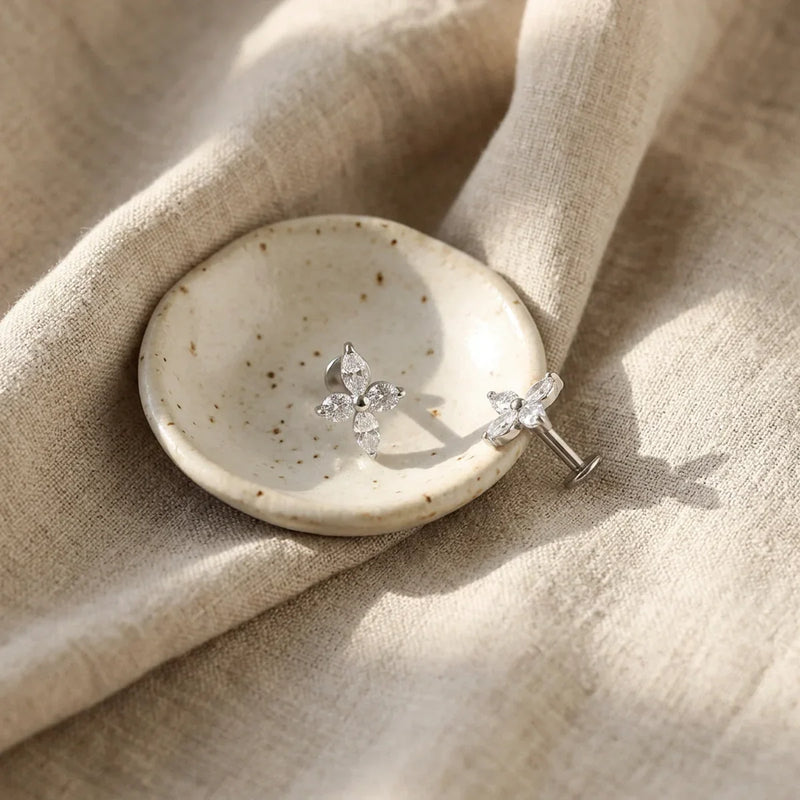
Plain round or square shapes stay sharp the longest. A small cubic zirconia stud adds a point of light without becoming flashy, as long as you keep the size modest. You can browse the full range of men's earrings in every style to compare shapes side by side.
Size, metal and comfort for everyday wear
An earring you can forget you are wearing is an earring you will actually wear. Comfort comes down to three things: the post, the metal and the back.
Post thickness
Most lobe earrings use a post of 20 gauge (about 0.8 mm) or 18 gauge (about 1.0 mm). If your piercing was done with a thicker needle, an 18 gauge post will feel more secure. Cartilage jewellery is usually 16 gauge (about 1.2 mm). If a post feels tight or loose, the gauge is usually the reason.
Metal and sensitive skin
Nickel is the most common cause of irritated piercings. It is found in many cheap alloys. If your ears get red, itchy or sore, look for:
- Titanium: implant-grade titanium is nickel-free and very light.
- 316L stainless steel: it does contain some nickel, but it is bound in the alloy and releases very little, so many people wear it without problems.
- 925 sterling silver: 92.5% silver, usually well tolerated, though it can tarnish over time.
Nothing is guaranteed safe for every single person, and if you have a known allergy it is worth asking a doctor. For a wider selection, see our earrings for sensitive ears.
The back
Butterfly backs are standard and easy to use. Screw backs are more secure if you play sport or sleep in your studs. Huggies use a hinged click closure, so there is no back to lose at all.
Getting pierced and switching sides
If you do not have a piercing yet, the side you choose now is not a lifelong decision. You can always add the other ear later, or let one close if you change your mind.
What to expect
- Lobe: usually heals in about six to eight weeks, sometimes longer.
- Cartilage (helix and similar): can take from several months up to a year.
- Starter jewellery: keep the first stud in for the whole healing period before you swap to hoops or dangles.
Go to a professional piercer who uses a sterile needle, and follow their aftercare advice. Clean gently, avoid twisting the jewellery and keep hair products away from the fresh piercing.
Adding a second piece
Once the first piercing has healed, many men add a second lobe hole or a single helix ring on the same side. This "stacked" look reads as modern and intentional. A small stud below a snug huggie is the classic combination. Keep the two pieces in the same finish and let one of them be clearly smaller, so the eye reads them as a pair rather than as two competing earrings.
Styling your earring for work, weekends and events
The side you pick matters far less than matching the earring to the moment. Here is how to adjust without overthinking it.
- Office: a small stud or a slim huggie in silver or gold tone. Keep it to one piece per ear.
- Weekends: try a slightly larger hoop, or mix a stud in one ear with a huggie in the other.
- Weddings and evenings: a polished stud or a clean hoop. A short dangle works with an open collar.
- Gym and sport: flat studs with secure backs, or take them out entirely.
Want to go further than studs? Our guide to earring styles for men walks through hoops, huggies, dangles and cuffs in detail.
Common mistakes when you start wearing earrings
Most first-time wearers worry about the wrong thing. They spend weeks asking which ear guys wear earrings in, then pick an earring that is too big, too shiny or too uncomfortable to keep on. These are the slips worth avoiding.
Going too big too soon
A large hoop or a heavy drop can look great, but it is a lot to get used to on day one. Starting small lets you, and the people around you, adjust to the new look. You can always size up later.
Ignoring the metal
A cheap earring with an unknown alloy can turn a healed piercing red and itchy within a day. If that happens, it is rarely the piercing's fault. Switch to titanium, 316L steel or sterling silver and give the ear time to calm down.
Mixing too many finishes
Silver in one ear, gold in the other and a black ring on your hand can look busy. Keep to one or two finishes until you know what you like. A single consistent metal always looks intentional.
Forgetting the back
Losing a stud on the first night out is a classic. Check that the butterfly back is pushed far enough along the post, or choose a screw back or a huggie with a click closure. Read our overview of the different earring backs if you are unsure which one you have.
Hiding it
Finally, the biggest mistake is wearing an earring as if you are apologising for it. The side does not matter. The confidence does. Choose a piece you like and wear it like it has always been there.
Pieces to start with from Odelys
Whichever ear you choose, these four pieces cover the main looks. Wear one alone, pair them, or mix them across both ears.
- Men's silver ear studs: the cleanest daily option, for one ear or both.
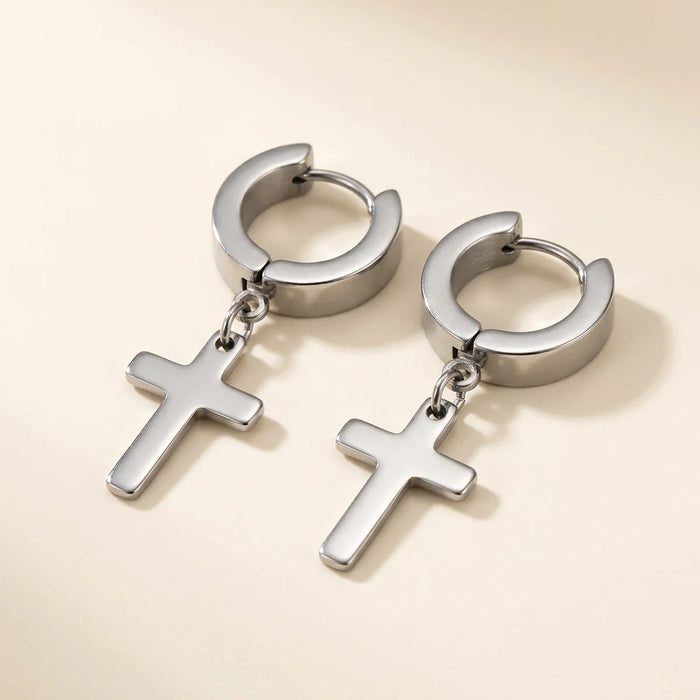
- Men's huggie earrings: a small hoop that hugs the lobe, so it stays put on calls and under helmets.
- Gold hoop earrings for guys: a warm gold-tone ring for when you want the earring to be noticed.
- Men's dangle earrings: a short drop with movement, best for evenings and weekends.
Start with one, see how it feels, and build from there. Your ears, your call.