Freshwater vs baroque pearls: what is the difference, and which should you choose?

Freshwater vs baroque pearls is a question that confuses almost everyone, because the two words describe different things. "Freshwater" tells you where a pearl grew: in a mussel living in a lake or river. "Baroque" tells you its shape: irregular rather than round. That means a pearl can be both at once, and in fact most baroque pearls sold today are freshwater pearls. This guide explains what each term means, how to tell real pearls from imitation ones, and how to choose earrings you will actually wear.
Freshwater vs baroque pearls: the short answer
Think of pearls as having two labels. The first label is the origin: freshwater, Akoya, South Sea or Tahitian. The second is the shape: round, near-round, button, drop, oval, semi-baroque or baroque. "Freshwater vs baroque" compares one label from each list, which is why the answer is not "one or the other" but "often both".
| Term | What it describes | Example |
|---|---|---|
| Freshwater | Origin: grown in a freshwater mussel | A small round white stud from a lake farm |
| Saltwater (Akoya, South Sea, Tahitian) | Origin: grown in a saltwater oyster | A classic round Akoya strand |
| Baroque | Shape: irregular, asymmetric, organic | A lumpy drop with folds and ridges |
| Semi-baroque | Shape: slightly irregular, a drop or oval with small bumps | A gently uneven teardrop |
| Imitation pearl | Material: made by hand or machine, not grown | A coated glass or shell bead |
So when you compare a "freshwater pearl earring" with a "baroque pearl earring", the real questions are: was the pearl grown in a mollusc or made in a workshop, and do you prefer a smooth round look or an irregular, sculptural one?
What are freshwater pearls?
Freshwater pearls grow inside mussels that live in lakes, ponds and rivers. Today almost all of them are cultured, which means a farmer opens a young mussel and inserts small pieces of mantle tissue from a donor mussel. The mussel reacts by coating the tissue in layer after layer of nacre, the same shiny material that lines its shell. After two to six years the pearls are harvested.
Two details make freshwater pearls different from most saltwater pearls. First, a single mussel can grow many pearls at once, often more than twenty, which keeps prices accessible. Second, because they usually start from a piece of tissue rather than a round bead, they are made almost entirely of nacre. That gives them good durability and a soft, satiny glow, and it is also why so many of them come out in irregular shapes.
Freshwater pearls come in a wide natural palette: white, cream, peach, pink and lavender. Darker shades such as black, grey, bronze or peacock green are usually created with a treatment after harvest, and a reputable seller should say so. Typical earring sizes range from about 4 mm for tiny studs to 10 mm or more for statement drops.
Perfectly round freshwater pearls are the rarest in every harvest. Most come out as ovals, buttons, drops and baroques, which is good news if you like character: the irregular ones are often the most interesting to look at and noticeably cheaper than a perfectly matched round pair.
What are baroque pearls?
A baroque pearl is any pearl with an irregular, non-symmetrical shape. The word is thought to come from the Portuguese "barroco", used for rough or imperfect pearls, and it later gave its name to the Baroque art style, with its curves and drama. In Italian, irregular pearls are also called "perle scaramazze".
Baroque pearls can come from any pearl-producing mollusc. There are freshwater baroques, Akoya baroques, South Sea baroques and Tahitian baroques. What they share is that something during growth pushed the nacre into folds, ridges, bumps or elongated shapes: a shift in the nucleus, a movement of the mollusc, or simply the way the tissue developed.
Jewellers group them into a few families:
- Semi-baroque: almost a drop or oval, with small bumps or a slightly flattened side.
- Baroque: clearly irregular, with ridges, waves and a lot of movement in the light.
- Keshi: small pearls formed without a nucleus, often petal-like and highly lustrous.
- Souffle and stick pearls: hollow, very light shapes or long flat "sticks" that look almost like sculptures.
Because no two are alike, each baroque pearl earring is a small one-off. That is the main reason designers love them: they feel personal, modern and a little rebellious next to the perfect round pearl of tradition.
Are baroque pearls real?
A natural or cultured baroque pearl is just as real as a round one. Its irregular shape is not a defect in the sense of poor quality; it simply sits lower on the shape scale, which is why baroques usually cost less than rounds of the same size and lustre. Quality still varies a lot, and lustre and surface matter far more than shape.
At the same time, the "baroque look" is very popular in fashion jewellery, so many baroque pearl earrings are made with imitation pearls: a glass, shell or resin base shaped irregularly and coated with a pearly finish. These can look beautiful and are much lighter on the wallet, but they are not grown in a mollusc and should always be described as imitation.
Here is how to tell them apart:
- Read the description. A clear listing says "freshwater pearl", "cultured pearl" or "imitation pearl". Vague words like "pearl-look" or "pearly bead" usually mean imitation.
- Look at the surface. Real pearls show tiny growth lines, slight colour variation and depth in the glow. Imitations often look very even, with a glossy, painted surface.
- Check the drill hole. On imitations, the coating can chip or peel around the hole and show a different material underneath.
- Feel the temperature and weight. Real pearls feel cool at first and slightly heavy for their size; plastic imitations feel warm and light.
- The tooth test. Rubbing a real pearl gently against the edge of a tooth feels slightly gritty; most imitations feel smooth. Do it carefully, or not at all on pearls you do not own.
Neither choice is wrong. Imitation baroque pearls are a great way to try the trend at a low price, while cultured freshwater pearls are the better buy if you want a piece that ages well and keeps its value as a gift.
Freshwater vs baroque pearls compared
To make the comparison useful, here is how a typical round or near-round freshwater pearl earring compares with a typical baroque one, whether cultured or imitation.
| Aspect | Round freshwater pearl | Baroque pearl (cultured) | Baroque pearl (imitation) |
|---|---|---|---|
| Look | Classic, polished, discreet | Organic, artistic, unique | Organic look, very even colour |
| Each pair | Closely matched | Never identical | Usually identical |
| Lustre | Soft and satiny | Often strong on the curves | Uniform shine from the coating |
| Durability | Good: solid nacre | Good: solid nacre | Coating can wear with time |
| Price | Mid-range | Usually below rounds of equal size | Lowest |
| Best for | Work, weddings, first pearls | Statement looks, modern styling | Trying the trend, outfits with a theme |
If you want a pearl you can wear with anything for years, start with a small round or near-round freshwater stud. If you already own a classic pair and want something with more personality, a baroque drop is the natural next step.
How pearl quality is judged
Whether a pearl is round or baroque, freshwater or saltwater, jewellers look at the same handful of factors. Knowing them helps you judge any pearl earring in a few seconds, even in a photo.
- Lustre: the most important factor. Good lustre means sharp, bright reflections that seem to come from inside the pearl. Poor lustre looks milky or chalky. Baroque pearls often have excellent lustre on their curves, because the light bounces off many angles at once.
- Surface: small spots, dimples or growth lines are normal and prove the pearl is organic. What you want to avoid are deep pits, cracks or worn patches where the nacre is thin.
- Shape: round is the rarest and most expensive, followed by near-round, drop, button, oval, semi-baroque and baroque. For baroque pearls, the question is not "how round" but "how attractive": a balanced, flowing shape is worth more than a random lump.
- Colour: body colour plus overtone, the subtle pink, green or silver sheen that floats over the surface. Pick the colour that flatters your skin; there is no single "best" one.
- Size: measured in millimetres across the widest point. Bigger pearls take longer to grow, so price rises quickly with every millimetre.
- Matching: for earrings, the two pearls should look like a pair. With baroques, exact matching is impossible, so sellers aim for a similar size, colour and overall silhouette.
Nacre thickness is a sixth factor for saltwater pearls grown around a bead. For most freshwater pearls it matters less, because they are almost all nacre from the start, which is one more reason they are such good value for everyday earrings.
How much do baroque pearl earrings cost?
Prices span a huge range, and the label "baroque" alone tells you little. Fashion earrings with imitation baroque pearls usually cost the same as other costume jewellery. Cultured freshwater baroque earrings on sterling silver sit in an accessible middle range, while large South Sea or Tahitian baroques from fine jewellers can cost hundreds or thousands. When you compare prices, compare like with like: the type of pearl, its size and the metal of the hook or post explain most of the difference.
How to wear baroque pearl earrings
The beauty of a baroque pearl is that it takes the formality out of pearls. A single irregular drop looks relaxed with a white T-shirt and jeans, yet still polished enough for dinner. Here are a few ways to make it work:
- With knitwear and denim: a baroque drop on a simple gold-tone hook adds light near the face without looking dressy.
- With a black dress: choose a larger, more sculptural pearl and keep everything else minimal. Our guide to earrings to wear with a black dress has more pairings.
- In an ear stack: mix one baroque drop with small hoops or a tiny stud in the second hole. The contrast between smooth metal and organic pearl is very current.
- Mismatched on purpose: since every baroque is different, wearing two slightly different pearls feels intentional rather than accidental.
- For a modern bride: a baroque drop is an alternative to the classic round stud, especially with a minimal or bohemian dress.
Hair matters too. A pearl drop shows best with hair tucked behind the ear or pulled into a low knot, so the irregular shape catches the light every time you move. For more ideas on occasions, read when to wear pearl earrings.
How to choose and care for pearl earrings
Whatever pearl you choose, a few simple checks help you buy well:
- Lustre first: look for a bright, deep reflection rather than a chalky or flat surface.
- Surface: small marks are normal in natural products, but deep pits or cracks near the hole are not.
- Metal: if your ears are sensitive, check the hook or post material. Sterling silver and titanium posts are good options; see our guide to the best earrings for a nickel allergy.
- Size and weight: a large baroque drop can be heavier than it looks. For everyday wear, 8 to 12 mm is comfortable for most lobes.
- Closure: hooks show off movement, studs feel more secure. Our guide to types of earring backs explains the options.
Pearls, real or imitation, are softer than gemstones and react to chemicals. Follow the old rule "last on, first off": put earrings on after perfume, hairspray and make-up, and take them off before showering, swimming or exercising. Wipe them with a soft, slightly damp cloth after wearing, let them dry flat and store them in a soft pouch, away from harder jewellery that could scratch them. Never use ultrasonic cleaners, bleach or silver dips on pearls.
If a pearl starts to look dull, do not try to polish it with jewellery cloths meant for metal: they can scratch the surface. A gentle wipe and a short rest away from cosmetics is usually all it needs, and wearing pearls regularly actually helps, because the natural moisture of the skin keeps the nacre from drying out.
Imitation pearls need the same gentle care, perhaps even more, because their coating can wear thin where it rubs against skin or metal. Treated this way, both kinds keep their glow far longer.
Our pearl earrings: what is real and what is imitation
We believe you should always know what you are buying, so here is exactly what each of our pearl styles is made of:
- Silver pearl earrings: white cultured freshwater pearls set on 925 sterling silver studs, a classic first pearl.
- Black pearl earrings: dark freshwater pearls on a gold-plated 925 sterling silver hook.
- Baroque pearl earrings: an irregular imitation pearl on a hook ear wire, for the baroque look at an easy price.
- Gold pearl drop earrings: a water-drop imitation pearl on a gold-plated setting.
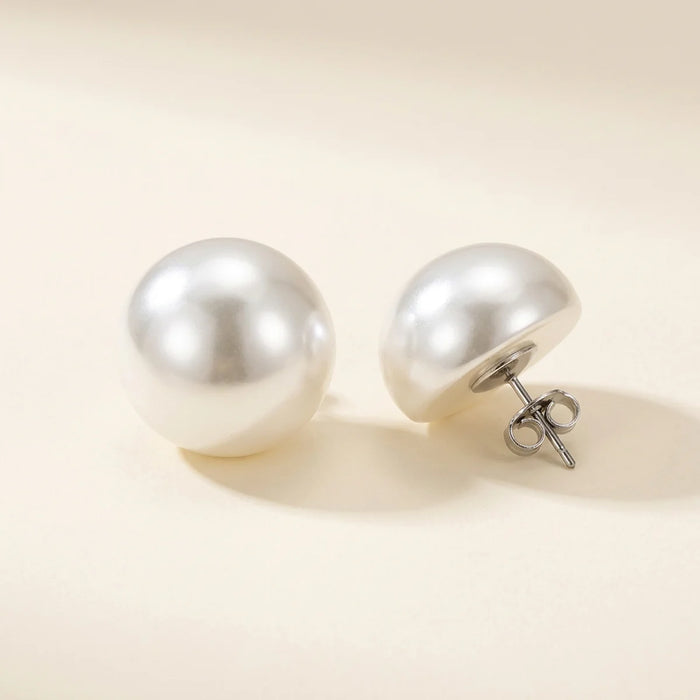
- Big pearl earrings: 2 cm round imitation pearl studs for a bold, graphic look.
- Long pearl earrings: an imitation pearl with a fine chain tassel for movement.
See every style, from tiny studs to statement drops, in our pearl earrings collection, or browse more drop earrings if you love movement.